Gyanmor Case Study: Building an AI Textbook Tutor Web App in Gujarati, Hindi and English
How Gyanmor turns one textbook into a living classroom: a page-flip reader, Guru the AI tutor that answers from the pages a teacher taught, and practice tests on the same pages.
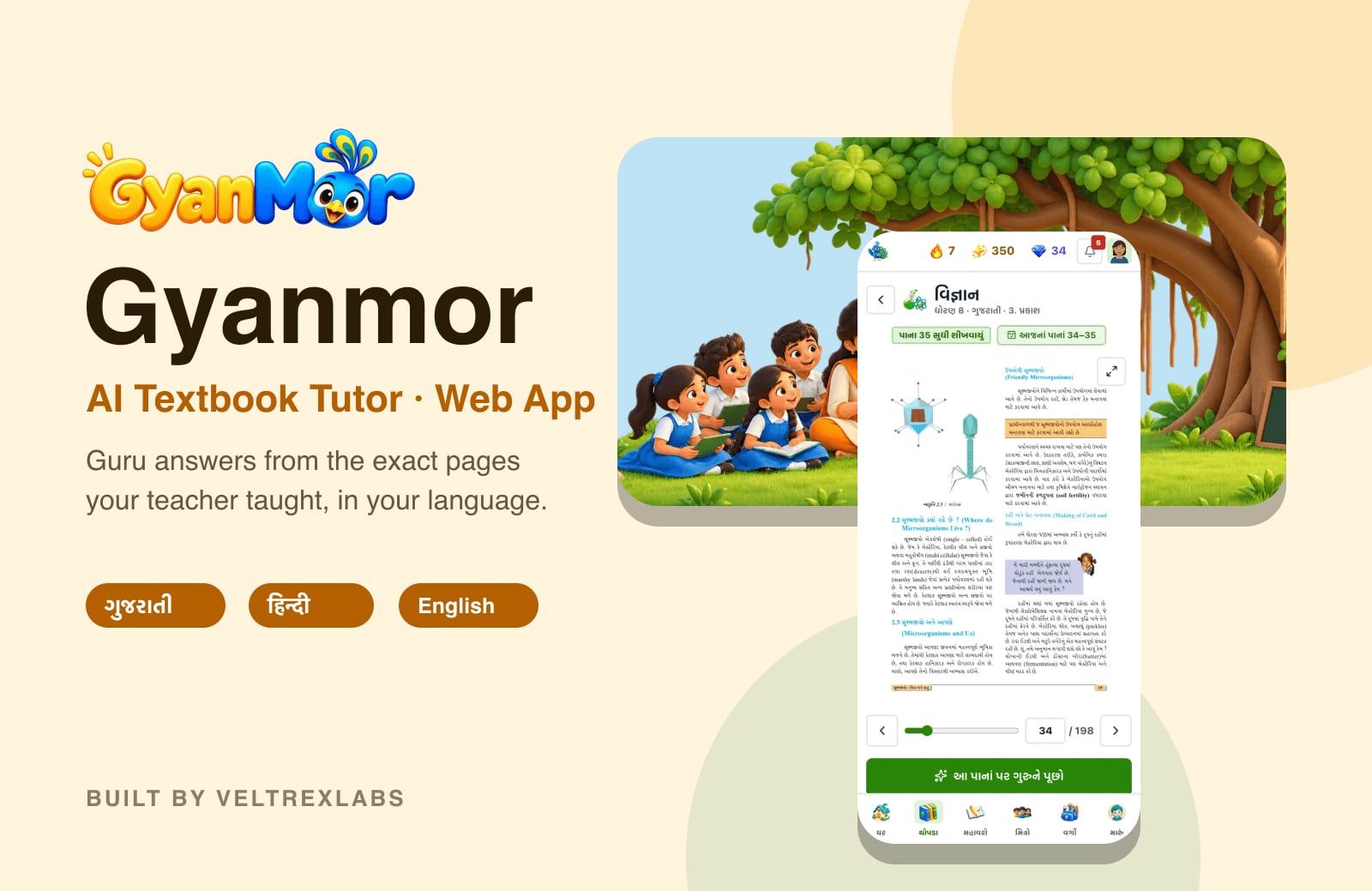
Gyanmor is a web app that turns one textbook into a living classroom: a page-flip reader, an AI tutor called Guru that answers from the exact pages the teacher marked, and quizzes and tests built on the same pages. It works in Gujarati, Hindi and English. This case study explains why a web app was the right format and what the product design gets right for students, parents and schools.
| At a glance | |
|---|---|
| Product | Gyanmor — AI textbook tutor |
| Platform | Web app (browser, any device) |
| Audience | Students, parents, teachers and schools |
| Languages | Gujarati, Hindi, English (Gujarat first) |
| Model | Free plan, family plans, school pricing per student |
| Website | gyanmor.com |
The challenge: homework help that knows your book
General AI tools explain anything, but a Class 8 student needs help with this chapter in this textbook, in the language they think in. Teachers need to know the explanation matches what they taught. The brief was an AI tutor grounded in the textbook itself, easy for a child to start and easy for a school to adopt.
Design decisions that mattered
1. Pages first, chat second
The product loop is three steps every school day. The teacher marks today's pages (or the student picks them when studying alone), Guru explains those pages, and the student practises with quizzes, tests and mistakes to fix drawn from the same pages. Because the context is the textbook, answers stay on-syllabus. The home screen makes this literal: today's pages from the teacher sit right on Home, and the reader has an "ask Guru about this page" button at the bottom.
2. A reader that feels like a book
Students can read in a page-flip reader, zoom into any page, resume where they stopped, or add their state's free textbook PDF. Keeping the original page in view builds trust: the student sees the source of the explanation, not just the answer.
3. Language first
The first screen asks for a language — Gujarati, Hindi or English — before anything else, and the interface, tutor and content follow that choice. For learners the tool that explains in their own language is the one they return to.
4. Easy sign-in for children and schools
Younger students rarely have email addresses. Gyanmor lets them sign in with a class code and a picture PIN, while learners under 18 need a parent's approval to create an account. Privacy is stated plainly: only essential cookies, no ads and no tracking.
5. Pricing that matches how schools buy
- Free: ₹0 — 4 Guru answers a day, books and practice papers.
- Lite, Plus and Premium for families — listed as opening soon, with nothing renewing automatically until then.
- Schools: from ₹399 per student per year, after a free 60-day pilot.
A free pilot lowers the risk for a principal, and a per-student price is simple to budget. Prices were correct when we wrote this; check gyanmor.com for current plans.
A restrained interactive hero
The landing page uses a layered scene — back, middle and front — that gives the classroom under the banyan tree depth as you move through it, with a sound toggle and a playful "Pull me" prompt. It adds character without hiding content: the headline and the call to action are real text, and the three-step explanation sits right below. That is the pattern we recommend for interactive sites generally.
When scroll-driven 3D is worth it, when it is not, and the SEO rules that keep it fast.
Read: choosing the right formatWhat we would do next
- Add structured data (Organization, SoftwareApplication, FAQPage) and a descriptive title on the language-selection home so search engines see the product, not just a menu.
- Publish teacher and parent testimonials and learning outcomes once approved.
- Expand to more state boards as content is added.
Lessons for your own web app
- 1.Ground AI in the user's own material. Context beats cleverness.
- 2.Remove sign-in friction for your least technical user.
- 3.Show prices, free limits and data practices openly.
- 4.Choose the web when the first minute matters more than a home-screen icon.
The project page lists the approach, and the live product is at gyanmor.com.
View Gyanmor in our workTell us the audience, the languages and the one job the product must do.
Talk to VeltrexLabsFrequently asked questions
What is Gyanmor?
Gyanmor is a web app that combines a textbook reader, Guru the AI tutor, and tests and practice built on the exact textbook pages a teacher marked for the day. It works in Gujarati, Hindi and English, and is built Gujarat first.
How does Gyanmor's AI tutor differ from a general chatbot?
Guru answers from the pages the teacher marked, or the pages a student picks when studying alone, rather than from the whole internet. That keeps explanations aligned to the textbook the class is actually using, in the student's own language.
How much does Gyanmor cost?
There is a Free plan at ₹0 with 4 Guru answers a day plus books and practice papers. Paid plans for families — Lite, Plus and Premium — are listed as opening soon, and schools are priced from ₹399 per student per year after a free 60-day pilot. Prices are shown on gyanmor.com and may change.
Can children use Gyanmor safely?
Learners under 18 need a parent's yes before they make an account. Students can also sign in at school with a class code and a picture PIN, and the site uses only the essential cookies needed to keep people signed in, with no ads and no tracking.
Why build Gyanmor as a web app instead of a mobile app?
Families and schools need to start in seconds from a link or a class code, on whichever device is available. A web app removes the install step and works across phones, tablets and school computers.
Tejas Patel
Founder & CEO, VeltrexLabs
Tejas is the Founder & CEO of VeltrexLabs, a product-focused development agency that has shipped MVPs for 13+ startups across food-tech, SaaS, e-commerce, and enterprise software.
Have a question about this?
Ask us directly. We answer within one working day, whether you are in India, the UK, Europe or the US.
Free tools
Continue reading
Next.js vs WordPress for a Business Website: Which Should You Choose?
Read articleWeb DevelopmentMultilingual Websites and Apps: A Practical Guide to Gujarati, Hindi and English (Design, SEO, hreflang)
Read articleWeb DevelopmentCore Web Vitals Explained for Business Owners: What They Are and How to Pass
Read articleWeb DevelopmentHow to Write a Meta Title and Description That Get Clicks (With Examples)
Read article

Ready to Transform Your Digital Presence?
Take the first step towards digital success with VeltrexLabs by your side. Our team of experts is eager to craft tailored solutions that drive growth for your business. Whether you need a stunning website, a powerful mobile app, or a data-driven marketing campaign, we've got you covered. Let's embark on this transformative journey together.
Unlock Your Digital Potential Today